0

Studio for Communication

Strategy and Design

Branding for B2B companies in practice.

Consistent communication
is an effective sale.

You are reading:

Branding for B2B companies in practice.

We help B2B companies organize communication, build credibility and shorten the customer's path to decisions. We create branding that works — in an offer, in a meeting, on LinkedIn and in every document that leaves your inbox.

Why B2B needs a different approach

In B2B brands, emotions don't disappear — they just change the language.
Here decisions are longer, based on trust, experience and consistency of the message.
Therefore, B2B branding must not only be visually attractive, but above all reliable and repeatable — in communication, offers, presentations and relationships.

B2B Branding in Practice

Branding that organizes, gives credibility and coherence to the organization.

For our clients, branding is not only an aesthetic issue — it is a well-thought-out, efficient system.
Designed so that every person in the company knows how to speak, how to show and how to react.


This is what we call Brand Coherency — the consistency between the promise and the reality of the brand.

Thanks to her:

  • marketing and sales communication begin to speak with one voice,
  • each presentation looks like a part of a larger whole,
  • the team gains work tools that put the chaos in order,
  • and customers understand more quickly what you do and what makes you different.
Branding process for B2B companies

We don't start with the logo.
We start by understanding how your brand works in everyday life — in relationships, documents, conversations with customers, and in the middle of the organization.
Our goal is to create a system that combines strategy, design and brand experience into one.

Process stages

01

02

03

04

05

06

Brand diagnosis
and positioning

Strategy

and Message House

Visual and
linguistic system

Brand materials

Social Media

Training and implementation
of Brand Coherency

We analyze what your communication system looks like today: from your website, through customer offers to LinkedIn.


We figure out where the brand is losing consistency and how it can be fixed.


The result is a Brand Coherency diagnosis — a map of what works and what needs correction.

We build a framework for brand communication: promise, pillars and tone of voice.


We create a message house — an organization-wide language that combines sales, marketing and management.


This is the foundation for further branding and everyday communication.

We design visual identity and brand language based on strategy.

Every element — from the typography to the way of writing — has a common DNA.


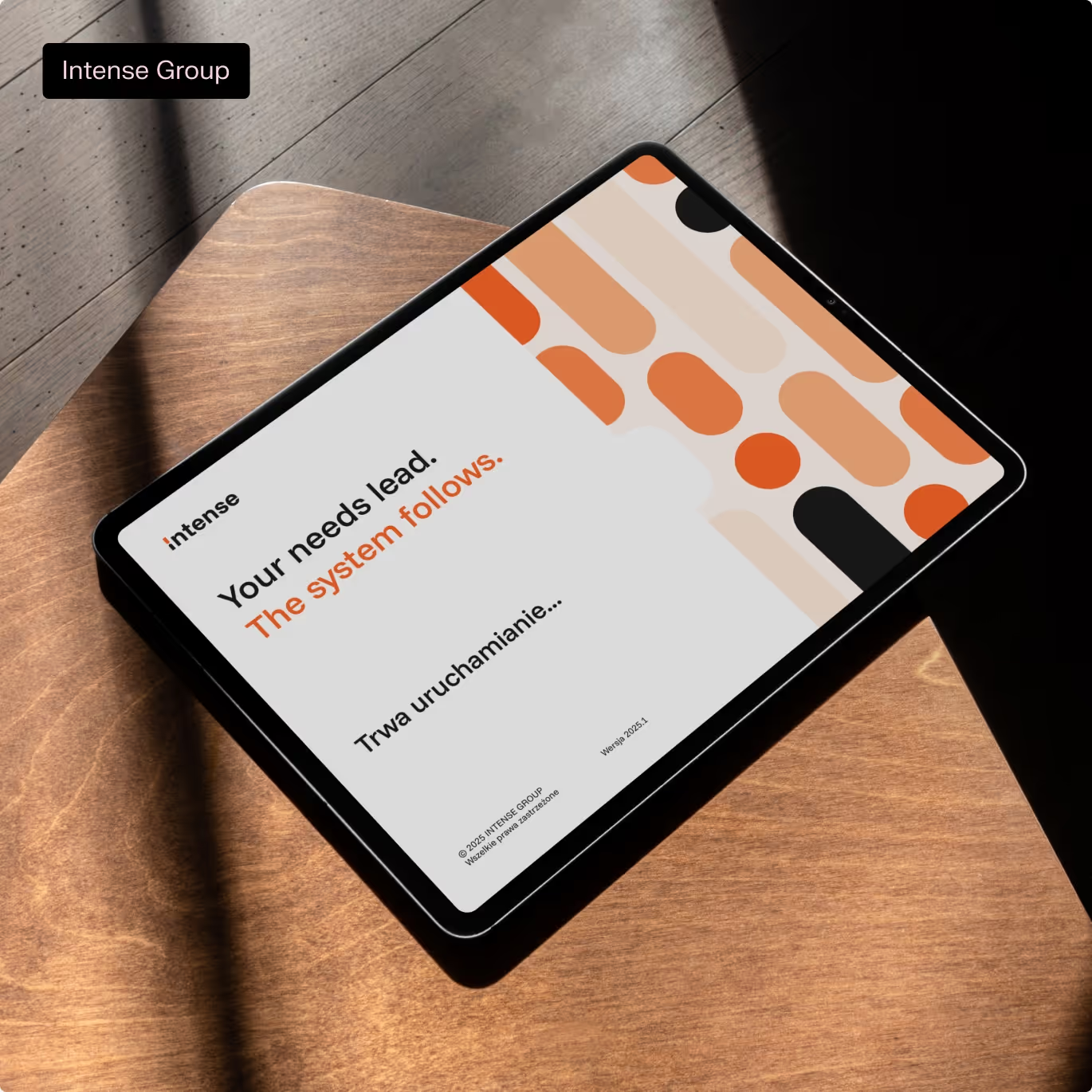
A coherent system is created that can be developed: brandbook, templates, design system, tone of voice.

Branding that works every day. This is the stage where the brand descends from the concept level to everyday practice.
We design a set of materials that build brand experience in real business situations:

  • commercial offers (product, service, partner),
  • sales and investor decks, management presentations and internal communications,
  • product cards, briefs, press releases,
  • Word templates, PowerPoint,
  • email footers and stationery
  • internal communication.

Each document is created based on a single visual and linguistic system, so that the brand is consistent at every touchpoint — not only in the campaign, but also in Excel, which reaches the customer.

LinkedIn and expert communication In B2B, LinkedIn is often an extension of the sales and PR office in one.
That's why we develop a SoMe communication system that is based on brand strategy rather than random ideas:

  • we define the language of the brand and the way of talking about the products,
  • we build a set of formats: expert posts, news, employer branding,
  • we design templates for posts and reports in Figma (or Canva),
  • we create sample entries and micro-copies that you can develop yourself.

We hand over the system to the team and teach how to use it.


We show how to maintain consistency over time, how to react 
for new situations and how to develop materials according to the rules of the brand.


As a result, the company becomes communicatively self-sufficient — not dependent on agencies, but on its own standards.

Etapy procesu

We analyze what your communication system looks like today: from your website, through customer offers to LinkedIn.


We figure out where the brand is losing consistency and how it can be fixed.


The result is a Brand Coherency diagnosis — a map of what works and what needs correction.

We build a framework for brand communication: promise, pillars and tone of voice.


We create a message house — an organization-wide language that combines sales, marketing and management.


This is the foundation for further branding and everyday communication.

We design visual identity and brand language based on strategy.

Every element — from the typography to the way of writing — has a common DNA.


A coherent system is created that can be developed: brandbook, templates, design system, tone of voice.

Branding that works every day. This is the stage where the brand descends from the concept level to everyday practice.
We design a set of materials that build brand experience in real business situations:

  • commercial offers (product, service, partner),
  • sales and investor decks, management presentations and internal communications,
  • product cards, briefs, press releases,
  • Word templates, PowerPoint,
  • email footers and stationery
  • internal communication.

Each document is created based on a single visual and linguistic system, so that the brand is consistent at every touchpoint — not only in the campaign, but also in Excel, which reaches the customer.

LinkedIn and expert communication In B2B, LinkedIn is often an extension of the sales and PR office in one.
That's why we develop a SoMe communication system that is based on brand strategy rather than random ideas:

  • we define the language of the brand and the way of talking about the products,
  • we build a set of formats: expert posts, news, employer branding,
  • we design templates for posts and reports in Figma (or Canva),
  • we create sample entries and micro-copies that you can develop yourself.

We hand over the system to the team and teach how to use it.


We show how to maintain consistency over time, how to react 
for new situations and how to develop materials according to the rules of the brand.


As a result, the company becomes communicatively self-sufficient — not dependent on agencies, but on its own standards.

What follows from this?

The result is consistency that builds trust and speeds up purchasing decisions. B2B branding doesn't end with aesthetics — it starts with the organization of meaning.

When a brand speaks with one voice, the people on the other end feel calm and predictable. This is brand resonance — the effect of conformity between what you say, how you look and how you act. Thanks to the implementation of the Brand Coherency system:

  • each offer is logical and consistent with the image of the company,
  • Customers understand more quickly what you are an expert at.
  • the team works on common principles and language,
  • a brand grows by order, not by noise,
  • and every presentation, document and post reinforces the image — rather than distracting it.

Let’s build a brand that truly works for your business.

Lena Mitkova

Creative In Chief°

Book a consult with Lena
View our projects

FAQ

Frequently Asked
Questions

We start with a short audit — an overview of your materials: pages, offers, presentations and LinkedIn. Thanks to this, we can see what works and what needs to be sorted out. Then we arrange an online workshop or a meeting where we define together what the goal of the project is: order in communication, rebranding or a complete strategy. Only then do we create a detailed offer and schedule.

Ideally 2-4, with workshops, meetings and consultations to get to know the whole organization well - so as to collect the most complete data possible. We need a board representative (for strategic decisions), someone from sales and/or marketing and possibly someone who will later maintain the brand in daily communication. We do not require regular meetings — the key is a workshop at the beginning, several interviews and a final discussion of the system in full.

Yes, if they carry the value of recognition or emotional importance in the company. In a large part of rebranding, we maintain our identity, but we design a new, coherent system around it — so that the whole thing looks modern and works better in practice. This, in practice, means that the organization retains some elements of the system. Sometimes a facelift is enough, sometimes a complete refresh — we make the decision together with the client after the analysis.

Standard from 8 to 12 weeks. During this time, we go through the diagnosis, strategy, visual system and development of brand materials. With extended projects (with a new website or team training) the process is longer (depending on the level of complexity of the service and the availability of the team), but it is carried out in stages — you always see the results along the way.

Full, functional brand system at each of the contacts with the recipient. The system can be very roomy, but usually includes:

  • logo files and visual library,
  • brandbook or design system in Figma,
  • set of Office and SoMe templates,
  • language guidelines (tone of voice),
  • and training in the operation and maintenance of the system.

Thanks to this, the team is able to maintain consistency on its own — without the need to involve the agency for every minor adjustment.